Who gets to choose what’s important in the future?

tech meeting

Last week, I was reading an excellent Wired interview with Kate Crawford of AI Now, when a remark she made lodged itself into my head. It has been percolating there ever since, probably because the topic is a rather important one: if we’re talking about the social impact of tech, shouldn’t the conversation invite and include those with expertise outside of the field of technology?

“Of course!” you might chime in, “we should all have a say in what shapes our future!”. Agreed. And yet, despite noticeably more public conversation about the social impact and ethics of tech in recent months, it often feels as though many of the louder voices are of scientists and tech experts who are simply ‘turning their hand’ to the humanities.  Continue reading

Facebook wants you naked…and it’s for your own good

revenge porn

***UPDATE: Contrary to yesterday’s reporting, the BBC has now corrected its article on Facebook’s new “revenge porn” AI to include this rather critical detail:

“Humans rather than algorithms will view the naked images voluntarily sent to Facebook in a scheme being trialled in Australia to combat revenge porn. The BBC understands that members of Facebook’s community operations team will look at the images in order to make a “fingerprint” of them to prevent them being uploaded again.”

So now young victims will have the choice of mass humiliation, or faceless scrutiny… Continue reading

10 real-world ethical concerns for virtual reality

virtual reality.jpeg

There are lots of emerging ideas about how virtual reality (VR) can be used for the betterment of society – whether it be inspiring social change, or training surgeons for delicate medical procedures.

Nevertheless, as with all new technologies, we should also be alive to any potential ethical concerns that could re-emerge as social problems further down the line. Here I list just a few issues that should undoubtedly be considered before we brazenly forge ahead in optimism.

1.   Vulnerability

When we think of virtual reality, we automatically conjure images of clunky headsets covering the eyes – and often the ears – of users in order to create a fully immersive experience. There are also VR gloves, and a growing range of other accessories and attachments. Though the resultant feel might be hyper-realistic, we should also be concerned for people using these in the home – especially alone. Having limited access to sense data leaves users vulnerable to accidents, home invasions, and any other misfortunes that can come of being totally distracted.

2.   Social isolation

There’s a lot of debate around whether VR is socially isolating. On the one hand, the whole experience takes place within a single user’s field-of-vision, which obviously excludes others from physically participating alongside them. On the other hand, developers like Facebook have been busy inventing communal meeting places like Spaces, which help VR users meet and interact in a virtual social environment. Though – as argued –  the latter could be helpfully utilized by the introverted and lonely (e.g. seniors), there’s also a danger that it could become the lazy and dismissive way of dealing with these issues. At the other end of the spectrum, forums like Spaces may also end-up “detaching” users by leading them to neglect their real-world social connections. Whatever the case, studies show that real face-to-face interactions are a very important factor in maintaining good mental health. Substituting them with VR would be ill-advised.

3.   Desensitization

It is a well-acknowledged danger that being thoroughly and regularly immersed in a virtual reality environment may lead some users to become desensitized in the real-world – particularly if the VR is one in which the user experiences or perpetrates extreme levels of violence. Desensitization means that the user may be unaffected (or less affected) by acts of violence, and could fail to show empathy as a result. Some say that this symptom is already reported amongst gamers who choose to play first person shooters or roleplay games with a high degree of immersion.

4.   Overestimation of abilities

Akin to desensitization, is the problem of users overestimating their ability to perform virtual feats just as well in the real-world. This is especially applicable to children and young people who could take it that their expertise in tightrope walking, parkour, or car driving will transfer seamlessly over to non-virtual environments…

5.   Psychiatric

There could also be more profound and dangerous psychological effects on some users (although clearly there are currently a lot of unknowns). Experts in neuroscience and the human mind have spoken of “depersonalization”, which can result in a user believing their own body is an avatar. There is also a pertinent worry that VR might be swift to expose psychiatric vulnerabilities in some users, and spark psychotic episodes. Needless to say, we must identify the psychological risks and symptoms ahead of market saturation, if that is an inevitability

6.   Unpalatable fantasies

If there’s any industry getting excited about virtual reality, it’s the porn industry (predicted to be the third largest VR sector by 2025, after gaming and NFL-related content). The website Pornhub is already reporting that views of VR content are up 225% since it debuted in 2016. This obviously isn’t an ethical problem in and of itself, but it does become problematic if/when “unpalatable” fantasies become immersive. We have to ask: should there be limitations on uber realistic representations of aggressive, borderline-pedophilic, or other more perverse types of VR erotica? Or outside of the realm of porn, to what extent is it okay to make a game out of the events of 9/11, as is the case with the 08.46 simulator?

7.   Torture/virtual criminality

There’s been some suggestion that VR headsets could be employed by the military as a kind of “ethical” alternative to regular interrogatory torture. Whether this is truth or rumor, it nevertheless establishes a critical need to understand the status of pain, damage, violence, and trauma inflicted by other users in a virtual environment – be it physical or psychological. At what point does virtual behavior constitute a real-world criminal act?

8.   Manipulation

Attempts at corporate manipulation via flashy advertising tricks are not new, but up until now they’ve been 2-dimensional. As such, they’ve had to work hard compete with our distracted focus. Phones ringing, babies crying, traffic, conversations, music, noisy neighbors, interesting reads, and all the rest. With VR, commercial advertisers essentially have access to our entire surrounding environment (which some hold has the power to control our behavior). This ramps up revenue for developers, who now have (literally) whole new worlds of blank space upon which they can sell advertising. Commentators are already warning that this could lead to new and clever tactics involving product placement, brand integration and subliminal advertising.

9.   Appropriate roaming and recreation

One of the most exciting selling points of VR is that it can let us roam the earth from the comfort of our own homes. This is obviously a laudable, liberating experience for those who are unable to travel. As with augmented reality, however, we probably need to have conversations about where it is appropriate to roam and/or recreate as a virtual experience. Is it fine for me to wander through a recreation of my favorite celebrity’s apartment (I can imagine many fans would adore the idea!)? Or peep through windows of homes and businesses in any given city street? The answers to some of these questions may seem obvious to us, but we cannot assume that the ethical parameters of this capability are clear to all who may use or develop.

10.   Privacy and data

Last, but not least, the more we “merge” into a virtual world, the more of ourselves we are likely to give away. This might mean more and greater privacy worries. German researchers have raised the concern that if our online avatars mirror our real-world movements and gestures, these “motor intentions” and the “kinetic fingerprints” of our unique movement signatures can be tracked, read, and exploited by predatory entities. Again, it’s clear that there needs to be an open and consultative dialogue with regards to what is collectable, and what should be off-limits in terms of our virtual activities.

This list is not exhaustive, and some of these concerns will be proven groundless in good time. Regardless, as non-technicians and future users, we are right to demand full and clear explanations as to how these tripwires will be averted or mitigated by VR companies.

Facebook accused of limiting, not championing, human interaction

facebook reactions

Facebook have been in a press a lot this week, and there have been a flurry of articles asking how they might be brought back from the brink. The New York Times asked a panel of experts “How to Fix Facebook?”. Some of the responses around the nature of –and limitations to– our user interactions on the social network struck me as very interesting.

Jonathan Albright, Research Director at Columbia University’s Tow Center for Digital Journalism, writes:

“The single most important step Facebook — and its subsidiary Instagram, which I view as equally important in terms of countering misinformation, hate speech and propaganda — can take is to abandon the focus on emotional signaling-as-engagement.

This is a tough proposition, of course, as billions of users have been trained to do exactly this: “react.”

What if there were a “trust emoji”? Or respect-based emojis? If a palette of six emoji-faced angry-love-sad-haha emotional buttons continues to be the way we engage with one another — and how we respond to the news — then it’s going to be an uphill battle.

Negative emotion, click bait and viral outrage are how the platform is “being used to divide.” Given this problem, Facebook needs to help us unite by building new sharing tools based on trust and respect.”

Kate Losse, an early Facebook employee and author of “The Boy Kings: A Journey into the Heart of the Social Network”, suggested:

“It would be interesting if Facebook offered a “vintage Facebook” setting that users could toggle to, without News Feed ads and “like” buttons. (Before “likes,” users wrote comments, which made interactions more unique and memorable.)

A “vintage Facebook” setting not only would be less cluttered, it would refocus the experience of using Facebook on the people using it, and their intentions for communication and interaction.”

According to recent reports, “reactions” are being algorithmically prioritized over “likes”. Why? Well, we might suppose, for the same reason most new features are developed: more and greater insight. Specifically, more insight about our specific emotions pertaining to items in our newsfeed.

Understanding the complexity of something we type in words is difficult. Systems have to understand tone, sarcasm, slang, and other nuances. Instead, “angry”, “sad”, “wow”, “haha”, and “love” make us much easier to interpret. Our truthful reactions are distilled into proxy emojis.

I see two problems with this:

  • The first is that we are misunderstood as users. Distilling all human emotions/reactions into five big nebulous ones is unhelpful. Like many of the old (and largely discredited) psychometric tests questions, these reactions allow us to cut complexity out of our own self-portrayal. This means that, down the line, the data analytics will purport to show more than they actually do. They’ll have a strange and skewed shadow of our feelings about the world. We’ll then, consequently, be fed things that “half match” our preferences and – potentially –change and adapt our preferences to match those offerings. In other words, if we’re already half-misinformed, politically naïve, prejudiced etc., we can go whole hog…
  • The second problem is that discouraging us from communicating our feelings using language, is likely to affect our ability to express ourselves using language. This is more of a worry for those growing up on the social network. If I’m not forced to articulate when I think something is wonderful, or patronizing, or cruel, and instead resort to emojis (“love” or “angry”), then the danger is that I begin to think in terms of mono-emotions. With so many young people spending hours each day on social media, this might not be as far-fetched as it sounds.

If there’s a question-mark over whether social network’s cause behavior change, then it’s fine to be unbothered about these prospects, but given Silicon Valley insiders have recently claimed that the stats are showing our minds “have been hijacked”, then perhaps it’s time to pay some heed to these mechanisms of manipulation.

Will robots make us more robotic?

robot dalek

Anyone who has taken public transport in San Francisco will tell you: it is not strange and unusual to encounter the strange and unusual. Every day is one of eyebrow-raising discovery. That said, I surprised myself recently when I became slightly transfixed –and perhaps a little perplexed– listening to someone narrate a text message into their smartphone.

The expressionless and toneless girl carefully articulated each word: “I can’t believe she told you”, she said aloud like a Dalek, “LOL”. How odd it seemed to see someone sat, stoney-faced, proclaiming that they were “laughing out loud” when nothing could be further from the truth.

Now, I have a limited background in acting, and I worked in-and-around politics for several years, so believe me when I say I’ve heard people speak robotically without any conviction or inflection before. But those people were reading scripts, or trying to remember their lines-to-take, or trotting out meaningless straplines. They weren’t expressing their own thoughts and feelings to a friend.

Then yesterday, I stumbled across this blog about the evolution of interactions in the age of AI. In a rather sweet anecdote, the author talks about ordering his Alexa to “turn off the lights” and his young son questioning his manners and the absence of “please”. He goes on to ponder the future and how we might incorporate manners and niceties when instructing our digital assistants, lest we inhibit their range by limiting the vocabulary we use with them.

My thoughts went elsewhere. Though AI is developing to understand our expressions and feelings, it feels like we also have some evolving to do before we become used to addressing artificial systems as we would other humans. Moreover, with voice instructions and narrated text, there seems little need for sincerity or emotion. The text itself is either directly indicative – or free – of sentiment.

Where I’m getting to is this: might we humans begin to develop specific a type of robotic tone exclusively for non-social instructive language? For Alexa and co.? We already have a tone and style we reserve for babies, pets and (sometimes) older relatives. Will a whole new style of monosyllabic speech emerge for the purposes of closing garage doors, sending text messages, ordering plane tickets and browsing TV channels? A sort of anti-baby talk?

It’s fun to speculate about these things, and I’m certainly no linguist, but it’s difficult to see that the voice-activated future we’re promised wouldn’t have some implications for modes of speech. Will we flatten our language, or to the contrary, become hyper-expressive? We’re yet to find out, but we can only hope that the beautiful languages of the world aren’t somehow roboticized as we adapt to hands-free technologies and AI assistants.

Life imitating art: China’s “Black Mirror” plans for Social Credit System

social credit system

Yesterday, both Wired and the Washington Post wrote extensively about plans the Chinese government have to use big data to track and rank their citizens. The proposed Social Credit System (SCS) is currently being piloted with a view to a full rollout in 2020. Like a real-life episode of Charlie Brooker’s dystopian Black Mirror series, the new system incentivizes social obedience whilst punishing behaviors which are not deemed becoming of a “good citizen”. Here’s the (terrifying) run down:

  • Each citizen will have a “citizen score” which will indicate their trustworthiness. This score will also be publicly ranked against the entire population, influencing prospects for jobs, loan applications, and even love.
  • Eight commercial partners are involved in the pilot, two of which are data giants with interests in social media and messaging, loans, insurance, payments, transport, and online dating.
  • Though the “complex algorithm” used to generate a score by partner Sesame Credit has not been revealed, we do know there are five factors being taken into account:
    1. Credit history
    2. Ability to fulfil contract obligations
    3. The verification of “personal characteristics” (e.g. phone number, address etc.)
    4. Behavior and preference
    5. Interpersonal relationships
  • “Behavior and preferences” considers patterns of behavior and how they reflect upon the individual. For example, someone who plays ten hours of video games each day would be considered idle, whereas someone who buys lots of diapers would be considered a responsible parent.
  • “Interpersonal relationships” allows assessors to rate interactions between friends and family. Nice messages about the government are likely to help your score, but it can also be negatively affected by things your friends post online.

Black mirror

How do incentives work?

Well, just like the “NoseDive” episode of Black Mirror, there big benefits for model citizens:

  • 600 points: Congrats! Take out a Just Spend loan of up to 5,000 yuan (for use on the scheme’s partner sites).
  • 650 points: Hurrah! You can rent out a car without placing a deposit, experience faster check-ins at hotels and even experience VIP check-in at Beijing Airport.
  • 666 points +: There’s nothing sinister about this threshold! Enjoy! You can take out a loan of up to 50,000 yuan (from a partner organization).
  • 700 points: Yowzers! You can go to Singapore without armfuls of supporting documentation.
  • 750 points: Big dog! You can be fast-tracked in applying for a pan-European Schengen visa.

What about bad citizens?

If you fall short of government expectations, you can expect to know about it. Here’s how they plan to lower your quality of life:

  • Difficulty renting cars
  • Poor employment opportunities (including being forbidden from some jobs)
  • Issues borrowing money from legitimate lenders
  • Slower internet speeds
  • Restricted access to restaurants, nightclubs and golf clubs
  • Less likely to get a date (high points profiles are more prominent on dating websites)
  • Removal of the right to travel freely abroad
  • Problems with securing rental accommodation
  • Restrictions enrolling children in certain schools

You can read more detail and commentary here, but I’ve tried to present the basics.

This system takes no excuses and makes no effort to collect feedback. If, unpreventably, your score suffers a knock, then it is simply “tough luck”. It’s not difficult to see how it will entrench disadvantage and, in all likelihood, create a delineated two-tier society.

If someone you’re connected to (perhaps a relative) reduces your score by behaving “inappropriately” online or over a messenger, this could lead to your being denied a job, which in turn will reduce your chances of gaining credit, getting a rental apartment, a partner…etc etc. It’s difficult to escape the domino effect or imagine how an individual might recover enough to live a decent life in a system where each misdemeanor seems to lead to another compounding circumstance.

We can legitimately speculate that Chinese society, from 2020, will be one in which citizens heavily police each other, disconnect themselves (in every way) from the poor/low-scoring, report indiscretions at the drop of a hat for fear of association and reprisals, and adopt phoney behaviors in order to “game” their way to full state approval. Some have described it as a form of “nudging”, but nudge techniques still leave room for choice. This seems much more coercive.

Finally, some have argued that, although the Chinese SCS system seems extreme, it actually employs techniques that are already being used by internet giants to map our own behaviors as we speak. The Chinese system simply adds a positive or negative valence to these actions and distills them into a single score. Therefore, it is worth considering which elements of SCS we find unpalatable – if any at all – and reflecting upon whether we already assent to, or participate in, similar evaluations already…

Google search figures reveal interest in tech surged by 78% in last 12months

tech interest

I conducted some desk research today which I hoped would either reinforce or eliminate my hunch that general interest in all-things-tech is growing. Anyone who has read Daniel Kahneman’s fantastic book on the role of intuition in such judgments, will know that the only way that I can (possibly!) get away from making bold claims like “the general population are becoming more curious about the mechanisms of tech” is by somehow providing a statistical proof.

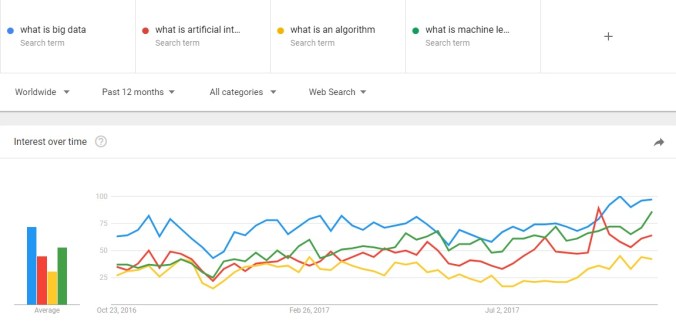
Enter Google Trends, and some rough – yet hopefully revealing – investigating on my part. Here’s where I got to:

Google trends

  • The popularity of the search term “what is Big Data” has increased by 54%
  • The popularity of the search term “what is an algorithm” has increased by 56%
  • The popularity of the search term “what is artificial intelligence” has increased by 83%
  • The popularity of the search term “what is machine learning” has increased by 132% (!)
  • The overall popularity of these tech-related search terms increased by 78%.

All the figures are over a 12-month period (Oct 2016 – Oct 2017), and my increases are based on Google Trends’ “interest over time measure” which assigns a value relative to peak popularity. It is also interesting to look at these same search terms over a longer period (see 3-year and 5-year charts) where the same trajectory can also be seen quite neatly.

My methodology, of course, is unashamedly unsophisticated. The list of terms I have used is certainly not exhaustive, and I’m aware that words like “algorithm” are not exclusive to the tech lexicon. I figured that the “what is” prefix would generally denote a novice search, and I would probably defend this as an as-good-as-anything-else, finger-in-the-air way to gauge if searches are from new, enquiring minds. Nevertheless, as discussed, my objective was to find some indication that my original intuition was correct. This is not intended to reflect a rigorous and conclusive study…

So, what does it mean? Well, it seems to confirm something that we all think we already know. Namely, that tech is migrating from the nerdy peripheries to center stage. And if we can reasonably assume these searches imply a quest for knowledge, then we might use this to speculate about a future where tech knowledge is decentralized, and better diffused throughout broader society.

Instinctively, this feels like a good thing. So many ethical discussions about tech focus on worries about privacy, manipulation, and the imbalance of power. When we talk about tech in society, the conversation can often turn to doomsday scenarios. But the upward lines on these charts might tell us something different. An interested and informed general population might help mitigate against ill effects in the next few years.

Furthermore, it’s easy to forget the many, many good things that are happening in tech which – with an increasingly engaged population – could truly benefit the whole of society. Just casually browsing the news this week, two very different stories caught my eye. The first was about 28-year old James Green, who believes his life was saved by his Apple Watch, which alerted him to a sudden and extreme increase in his heart rate and prompted him to seek urgent help for what turned out to be a deadly pulmonary embolism. The second was about Pinchas Gutter, a holocaust survivor and participant in the New Dimensions in Testimony project, which helps keep history alive by allowing (in this case) visitors to the Museum of Jewish Heritage in Toronto to interact with an image of Mr. Gutter, and ask questions about his experiences during the Nazi occupation of Poland.

In both cases – but in very different ways – technology, algorithms, data, and machine learning are being employed to save us. To increase our awareness in ways that (I believe) can only be described as positive.  The more we all understand about how these technologies work, the more likely it is that they will survive, thrive and new, similar ideas will evolve to the advantage of all of us.

This is, obviously, an optimistic view. But I think when we’re talking about ethics it can be important not to artificially suppress a well-founded glimmer of hope where it occurs. Only time how will tell how it will all play out.