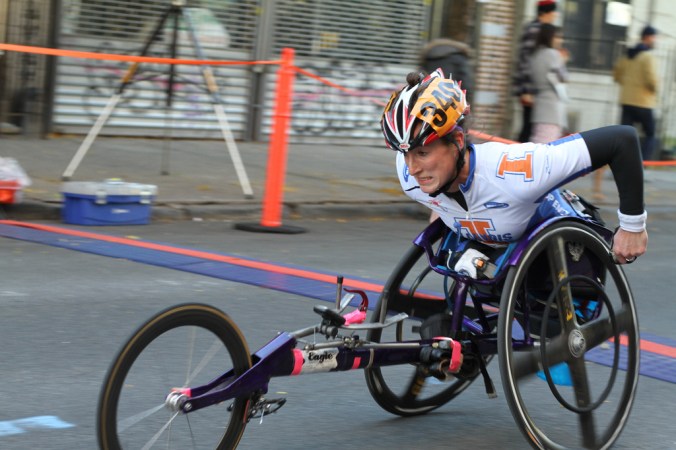
5 Disabling Barriers New Tech Is Helping To Smash Down For The Physically And Developmentally Impaired

assistive tech

Jenny Morris –  a disabled feminist and scholar –  has argued that the term “disability” shouldn’t refer directly to a person’s impairment. Rather, it should be used to identify someone who is disadvantaged by the disabling external factors of a world designed by and for those without disabilities.

Her examples: “My impairment is the fact I can’t walk; my disability is the fact that the bus company only purchases inaccessible buses” or “My impairment is the fact that I can’t speak; my disability is the fact that you won’t take the time and trouble to learn how to communicate with me.”

According to Morris, any denial of opportunity is not simply a result of bodily limitations. It is also down to the attitudinal, social, and environmental barriers facing disabled people. Continue reading
Want Artificial Intelligence that cares about people? Ethical thinking needs to start with the researchers

We’re delighted to feature a guest post from Grainne Faller and Louise Holden of the Magna Carta For Data initiative.

The project was established in 2014 by the Insight Centre for Data Analytics  – one of the largest data research centres in Europe – as a statement of its commitment to ethical data research within its labs, and the broader global movement to embed ethics in data science research and development.

Magna Carta For Data 1

A self-driving car is hurtling towards a group of people in the middle of a narrow bridge. Should it drive on, and hit the group? Or should it drive off the bridge, avoiding the group of people but almost certainly killing its passenger? Now, what about if there are three people on the bridge but five people in the car? Can you – should you – design algorithms that will change the way the car reacts depending on these situations?

This is just one of millions of ethical issues faced by researchers of artificial intelligence and big data every hour of every day around the world. Continue reading

FEATURED MEDIA: “Letting Facebook control AI regulation is like letting the NRA control gun laws” – Quartz

Mark Zuckerberg

Writing for Quartz, international dispute lawyer, Jacob Turner, elaborates on the dangers of letting Silicon Valley execs set their own rules:

“We wouldn’t trust a doctor employed by a tobacco company. We wouldn’t let the automobile industry set vehicle-emissions limits. We wouldn’t want an arms maker to write the rules of warfare. But right now, we are letting tech companies shape the ethical development of AI.”

Read the whole article here: Letting Facebook control AI regulation is like letting the NRA control gun laws.

If you aren’t paying, are your kids the product?

There’s a phrase – from where I don’t know – which says: “If you aren’t paying, you’re the product.”  Never has this felt truer than in the context of social media. Particularly Facebook, with its fan-pages and features, games and gizmos, plus never-ending updates and improvements. Who is paying for this, if not you…and what are they getting in return? The answer is actually quite straightforward.

children

Continue reading

6 Tech Terms Every Adult Should Learn About To Avoid Being Left Behind

adults

Not for the first time, Apple CEO Tim Cook has spoken out this week about how important it is for children to learn computer code. He’s not alone in believing that this “language of the future” will be critical for kids growing up right now. In a sea of unknowns one thing appears to be certain: technical understanding is a very valuable asset indeed.

It’s interesting then, that in spite of remarkable efforts to equip the adults of tomorrow with such skills, very little is being done to familiarize young adults, middle-aged parents, or retirees (with impressively long-life expectancies!) with the signature terms of the “AI Age”. This seems a like an oversight. Continue reading

All teens make mistakes, but hyperconnected Generation Z faces steeper consequences

Teenage Young Teen Youth Portrait Tween Casual

Last week a young contestant on a British reality TV show was left humiliated after producers chose to remove him from the program’s Australian jungle setting after just a couple of days. Their reason? Tweets and social media messages sent in 2011, when the vlogger was in his teens.

Now let’s be clear, the things that Jack Maynard said were unpalatable and offensive. They are not acceptable sentiments in any scenario, and certainly not from someone with a YouTube reach of several million and an incredible leverage over (predominantly) teenage girls.  Nevertheless, watching a young man’s fledgling media career left in tatters should prompt us to sharpen our focus on an increasingly important question: in our hyperconnected era, to what extent can we punish and pillory the adult for the sins of the teen?   Continue reading

Five AI misnomers (probably)

artificial intelligence

Not being an artificial intelligence “expert”, an egghead, or a mad scientist, I can sometimes find the trajectory of AI confusing. In my reading, I’ve come across evidence to convince me in entirely contradictory directions, and there is certainly a lot of tension in the public conversation.

Are we in the run-up to an AI apocalypse? A technological utopia? Or, even with all our computational power, is AI still as dumb as a rock?  Continue reading

Who gets to choose what’s important in the future?

tech meeting

Last week, I was reading an excellent Wired interview with Kate Crawford of AI Now, when a remark she made lodged itself into my head. It has been percolating there ever since, probably because the topic is a rather important one: if we’re talking about the social impact of tech, shouldn’t the conversation invite and include those with expertise outside of the field of technology?

“Of course!” you might chime in, “we should all have a say in what shapes our future!”. Agreed. And yet, despite noticeably more public conversation about the social impact and ethics of tech in recent months, it often feels as though many of the louder voices are of scientists and tech experts who are simply ‘turning their hand’ to the humanities.  Continue reading

Facebook wants you naked…and it’s for your own good

revenge porn

***UPDATE: Contrary to yesterday’s reporting, the BBC has now corrected its article on Facebook’s new “revenge porn” AI to include this rather critical detail:

“Humans rather than algorithms will view the naked images voluntarily sent to Facebook in a scheme being trialled in Australia to combat revenge porn. The BBC understands that members of Facebook’s community operations team will look at the images in order to make a “fingerprint” of them to prevent them being uploaded again.”

So now young victims will have the choice of mass humiliation, or faceless scrutiny… Continue reading