A Birth, a Bereavement, and the Essence of Snoop Dogg

Tech needs better definitions
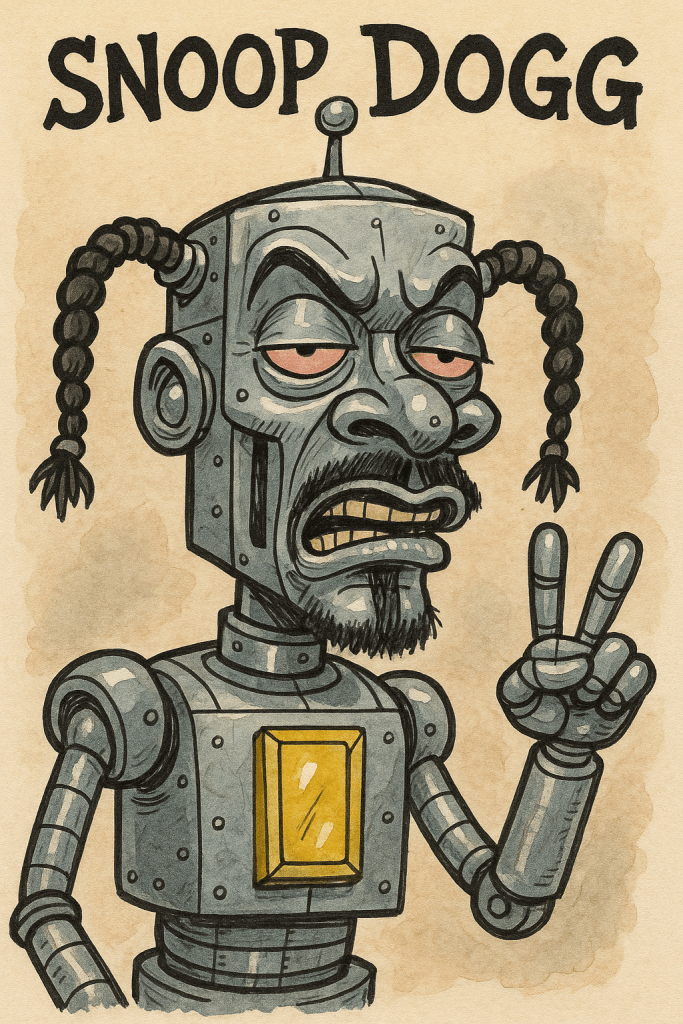
Dall-E at it’s absolute finest

As the curtain fell on 2024, I had a baby. It was Friday the 13th, a date often associated with bad luck thanks to European superstitions stretching back a couple of hundred years. There is even a specific term to describe the “fear of Friday the 13th”: paraskevidekatriaphobia. Although urban legend actually has it that the shrink that coined it declared anyone who learned to pronounce it would be cured, which suggests a sense of humor (and reminds us how extra humans can be…).

And while my husband and I likewise noted the date as a humoress quirk, bad luck would, in fact, catch-up with us. Just five weeks later my Dad died. Baz Luhrman was onto something when he said the real troubles in life blindside you on an idle Tuesday afternoon.

Though he’d been ill for a while my father’s passing wasn’t expected, and I found myself in the strange and bewildering position of both gaining and losing a fundamental life force in such quick succession that it felt simultaneous. In the paperwork and aftermath, I occasionally confused my father’s DOD for our baby’s DOB. Those who have had similar experiences may relate to the feeling of being in some strange existential continuum, whereby it seems impossible that there wasn’t some kind of transfer. Like one Dr. Who fluidly regenerating into the next

Continue reading

Missives from Cannes: Three Observations on Gen AI Application

Enthusiasm abounded at the World AI Cannes Festival

La Croisette de Cannes dans les années 1930

By now, we’re well-accustomed to waves of tech-based fervor. You don’t really have to touch the industry to have become a cynic. Perhaps you remember “peak blockchain” in 2019, when the technology was integrated into a toothbrush for reasons that no-one will ever begin to understand?

And of course, we’ve endured fanfare and furor over the metaverse, XR, Big Data, crypto, Web3, NFTs, quantum computing and, most notably, we’ve seen AI grow legitimate roots as the defining technology of its era (while its name continues to be frequently used and abused by sneaky bandwagon jumpers…).  

On those firm foundations, generative AI is the term at the center current hype-cycle. In Cannes last week a reported 16,000 attendees swarmed on the famed Palais des Festivals et Des Congrès to learn about it, talk about it, and – for many – showcase the tentative steps they’ve taken towards real-world application.

As with previous seasons, there was an urgency (perhaps even a whiff of desperation…?) in the air as companies from industries as diverse as hospitality, finance, entertainment, marketing, and pharma joined this latest gold rush as hopefuls. And, unsurprisingly, both snake oil and substance could be found.

I was lucky enough to host the festival’s Applications Stage, and here are three broad-brush observations I made:

Continue reading

ChatGPT: A Cautionary Tale (With Some Positive Takeaways)

I haven’t posted in a while. In truth, there hasn’t been a lot that’s piqued my interest, and there are now elaborate global mechanisms and a squadron of eager commentators prepped and ready to address the issues I used to point at on this humble blog. In November, I could’ve written something predictable about the impact of ChatGPT, but I felt like I’d already played that tune back in 2020 when I attempted to summarize the intelligent thoughts of some philosophers.

ChatGPT. GPT-3. Potato. Potato.

The most interesting aspects of this kind of AI are yet to come, I don’t doubt that. But I am here to share a cautionary tale that syncs nicely with my ramblings over the last 5 (5??) years. It’s a story about reliance and truth. About the quest for knowledge, and how it almost always involves some level of fumbling around in the dark, but never more so than now.

The Uncanny Valley and the Meaning of Irony

There has been a lot of discussion about how human is too human when it comes to robots, bots, and other types of disembodied AI voices. An interest in this topic led to a frustrating Google search which led me to…you guessed it…ChatGPT.

What did we ever do without it? I’m starting to forget.

Continue reading

Vaccine Passport Apps: The Latest Covid Tech Is Upon Us

This image has an empty alt attribute; its file name is vaccinepassport.jpg

The concept of a passport is probably older than you think. Though it might be heavily associated with the early days of international air travel, the documents actually date back to the early 15th century. Indeed, Shakespeare himself has King Henry V use the term in his famous Crispin’s Day speech at the Battle of Agincourt:

Rather proclaim it, Westmorland, through my host,

That he which hath no stomach to this fight,

Let him depart; his passport shall be made.” (Henry V, Act IV, Scene iii)

Continue reading

Why Employee Surveillance Is Not Okay

File:An analysis of horsemanship - teaching the whole art of riding, in the manege, military, hunting, racing, and travelling system - together with the method of breaking horses, for every purpose to (18165467302).jpg

Writing for Aeon last week, Martin Parker, a professor of organization studies at the University of Bristol in the UK, relayed the origins of the word “management”, explaining:

“It is derived from the Italian mano, meaning hand, and it’s expansion into maneggiare, the activity of handling and training a horse carried out in a maneggio – a riding school. From this form of manual control, the word has expanded into a general activity of training and handling people. It is a word that originates with ideas of control, of a docile or wilful creature that must be subordinated to the instructions of the master.”

Though we might prefer to believe that its meaning has evolved since then to convey something more respectful and collaborative, it is still the case that workplace leaders and managers have mastery over their staff. Promotions, opportunities, hirings and firings — all life-altering events — are subject to their authority. 

It is a mighty responsibility, and abuse of managerial power can have devastating consequences. 

Continue reading

Six Technologies Getting us Through the Pandemic

Bored

With COVID-19 lockdown restrictions issued across the globe, millions of us have been forced to hunker down “in place”, or severely limit our movements outside of the home. On learning this, most will have reached reflexively for the nearest device — if we didn’t learn it from that device to begin with. Yet mostly we are cinched in a love-hate relationship with the presiding artefacts of our time; and often we resent tech’s power over us

Nevertheless, new circumstances can breed new attitudes. Despite having spent the last few years debating whether or not technology will destroy us, March 2020 could be the month that at least partially redeems our faith in technology by demonstrating how fortunate we are to have some incredibly sophisticated tools in our homes.

For many, they are currently the sole portal to the outside world. 

Continue reading

The Evolution of Human-Centered Tech @ Last Month’s CES 2020

An edited version of this article appeared on the H+K Strategies website earlier this month. File:Ces-consumer-electronics-show-las-vegas-greg-bulla.jpg

The dust has now settled after the madness of the world’s biggest annual tech fest, the Consumer Electronics Show (CES) in Las Vegas, NV. Since the show’s kick-off in early January, a parade of weird and wonderful new devices have dominated tech news and bylines; from lab produced pork to RollBot, Charmin’s robotic savior for those “stranded on the commode without a roll.”

The event itself really isn’t for the faint-hearted. It’s easy to feel overwhelmed by the sheer volume of companies vying to embed their (often ridiculous) tech gadgetry into our lives – both at work and at play. There is, of course, lots of money to be made from finding that elusive sweet spot; the point at which problem-solving, convenience, and affordability converge.

Continue reading

If Virtual Reality is Reality, is Virtual Abuse Just Abuse?

girl-4474800_1920

“If you’ve got something that is independent of your mind, which has causal powers, which you can perceive in all these ways, to me you’re a long way toward being real”, the philosopher David Chalmers recently told Prashanth Ramakrishna in an interview for the New York Times. Chalmers invoked remarks by fellow Australian philosopher Samuel Alexander who said that: “To be real is to have causal powers”, and science fiction writer Philip K. Dick who said that, “a real thing is something that doesn’t go away when you stop believing in it.” 

Professor Chalmers’ comments were made in reference to the new and increasingly sophisticated world of virtual reality; something he believes has the status of a “subreality” (or similar) within our known physical reality. A place that still exists independent of our imaginations, where actions have consequences.

Chalmers draws parallels with our trusted physical reality, which is already so illusory on many levels. After all, the brain has no direct contact with the world and is reliant upon the mediation of our senses. As the mathematician-turned-philosopher points out, science tells us that vivid experiences like color are “just a bunch of wavelengths arising from the physical reflectance properties of objects that produce a certain kind of experience in us.” 

Continue reading